 By Dhruvisha J

A capsule wardrobe is one of the simplest ways to get dressed faster, spend smarter, and actually enjoy the clothes in your closet. Instead of a rail crammed with pieces you never reach for, it is a small, intentional collection of garments that mix and match with almost no effort. If you have ever stood in front of a full wardrobe convinced you have "nothing to wear," this guide shows you how to build a capsule wardrobe from scratch, without buying a thing until you know what you need.
It works for any budget, any body, and any lifestyle. All you need is a clear plan, a coherent colour story, and pieces that fit you well. A crisp white shirt is one of the first staples worth mastering, so it helps to know how to style a white shirt before you build the rest.
What is a capsule wardrobe
A capsule wardrobe is a curated set of clothing, usually 30 to 40 pieces, chosen so that almost everything works together. The term traces back to the 1970s, coined by London boutique owner Susie Faux for a handful of essential garments that never date. There is more history on Wikipedia's capsule wardrobe entry.
The core principle is interchangeability: every top pairs with most of your bottoms, so a modest number of garments makes a surprising number of outfits. Unlike a minimalist wardrobe, which owns as little as possible, a capsule owns the right things in the right proportions.
The real benefits
The advantages go well beyond a tidier closet.
- Faster mornings. When everything coordinates, getting dressed takes minutes.
- More money in your pocket. You stop buying impulse pieces and invest in fewer, better garments.
- Less waste. Buying intentionally is an effective sustainable fashion habit.
- Stronger personal style. A tight edit forces clarity about what genuinely suits you.
- Easier packing. A capsule wardrobe travels beautifully because the pieces already work as a system.
- More confidence. When you trust every item, you stop second-guessing your reflection.
How many pieces you need
There is no magic number, but a capsule wardrobe of 30 to 40 pieces per season hits the sweet spot for most people, excluding underwear, sleepwear, gym kit, and special-occasion outfits. A useful starting distribution looks like this.
| Category | Suggested count | Notes |
|---|---|---|
| Tops | 8–12 | Mix of tees, blouses, and knits |
| Bottoms | 5–7 | Trousers, jeans, a skirt or two |
| Dresses or jumpsuits | 2–4 | Optional, depending on your style |
| Layers | 4–6 | Cardigans, blazers, jackets |
| Outerwear | 2–3 | Seasonal coat plus a lighter option |
| Shoes | 4–6 | Everyday, smart, and weather pairs |
Adjust these numbers to your climate and routine. Someone who works from home needs fewer formal pieces than a client-facing worker. The point is proportion.
How to build a capsule wardrobe in 6 steps
Here is the method at a glance; each step is detailed below.
- Audit everything you own. Empty your closet, sort it honestly, and keep only what you wear and love.
- Choose a colour base. Pick a few neutrals and a few accents so any two pieces coordinate.
- Build your core staples. Lock in the versatile pieces that appear in outfit after outfit.
- Prioritise fit and quality. Buy fewer garments that fit, and use a tailor on the near misses.
- Fill the real gaps only. Shop from a short list of what is missing, never on impulse.
- Refresh with the seasons. Keep a steady core and swap a handful of pieces as the weather turns.
Step 1: Audit what you wear
The first step of building a capsule wardrobe involves zero shopping. Pull everything out of your closet and drawers and lay it where you can see it at once. This is the honest, uncomfortable part, and the most valuable one. Sort every piece into four piles.
- Love and wear: the pieces you reach for constantly. These are the heart of your capsule.
- Keep with reservations: items you like but rarely wear. Ask why. Fit? Colour? Occasion?
- Repair or tailor: good pieces let down by a loose button, a long hem, or a broken zip.
- Let go: anything that does not fit, does not suit you, or has not been worn in a year.
Notice patterns as you sort. Maybe you always gravitate to soft neutrals, or own five almost-identical striped tops. These clues reveal your real style. If you are unsure which silhouettes flatter you, our guide on how to dress for your body type pairs well with this audit. Snap a photo of every keeper so you can spot gaps later.
Step 2: Choose a colour base for your capsule wardrobe
A palette that hangs together is the engine of a capsule wardrobe. When your colours harmonise, almost any combination looks deliberate, so build around a small palette rather than random shades. Once the palette works, a few reliable outfit formulas to mix and match turn a handful of pieces into dozens of looks.
Start with two or three base neutrals that anchor most outfits, like navy, charcoal, camel, cream, or grey; choose ones that flatter your skin tone. Then add two or three accents that bring the palette to life, perhaps olive, blush, or burgundy. A good rule: two items that share an undertone usually get along.
Step 3: Build your core staples
With your palette set, define your staples: the hard-working pieces that appear in outfit after outfit. They rarely excite on the hanger, but they earn their place. Here is a starter list to adapt to your taste.
| Staple piece | Why it earns a spot | Style tip |
|---|---|---|
| White button-up shirt | Dresses up or down instantly | Look for a crisp, non-sheer cotton |
| Well-fitting jeans | The backbone of casual outfits | Choose a wash you can wear year-round |
| Tailored trousers | Smart yet comfortable | A mid-weight fabric holds its shape |
| Plain crew-neck tees | Layer or wear solo | Buy two or three in your neutrals |
| Knit jumper | Warmth and texture | Merino or lambswool wears longest |
| Structured blazer | Sharpens any look in seconds | Neutral colour, slightly relaxed cut |
| Little day dress | A one-and-done outfit | Pick a shape you can layer over |
| Versatile flat shoe | Comfort for everyday wear | Leather or quality vegan alternative |
Aim for staples to make up roughly 70 percent of your capsule, with statement pieces filling the rest. Then keep one discipline: when something new comes in, something tired goes out. That stops the capsule ballooning back into chaos.
Step 4: Fit and quality first
A cheap top that fits badly is expensive, because you will never wear it. Fit matters far more than the label inside. Take your bust, waist, hip, and inseam measurements and keep them handy, since sizes vary between brands. When buying online, our online shopping size guide turns those measurements into confident purchases.
Judge quality quickly: feel the fabric, since natural fibres like cotton, wool, and linen age gracefully; check the seams for tight stitching; hold it to the light, because thin fabric means a short lifespan; and stretch it to see whether it springs back. Tailoring is your secret weapon too: hemming trousers or taking in a waist costs little and improves the hang.
Step 5: Plan a seasonal refresh
Your capsule wardrobe should breathe with the seasons rather than sit frozen all year. Most people run a fresh capsule every three months, keeping a stable core and swapping a handful of pieces as the weather turns. Year-round pieces like jeans, a good blazer, and versatile shoes stay in rotation, while seasonal specifics swap in around them.
| Warm-season piece | Cold-season swap |
|---|---|
| Linen shirt | Wool jumper |
| Cotton shorts | Corduroy or wool trousers |
| Sandals | Ankle boots |
| Sundress | Knit dress with tights |
| Lightweight trench | Insulated wool coat |
| Straw tote | Structured leather bag |
A refresh should mean adding one or two thoughtful pieces, not starting over. If you replace half your capsule every quarter, your palette or staples need another look. Clean pieces before storing them so they come back fresh.
A real example, start to finish
A concrete example makes it click. Maya works a hybrid week split between the office and errands. Her palette is navy, cream, and grey, with olive and rust accents. Here is how she built a 30-piece capsule wardrobe in a weekend.
- She emptied everything onto the bed. Of 48 items, 19 survived the four-pile sort; the rest were donated, resold, or set aside for the tailor.
- She locked her palette: navy, cream, and grey as neutrals, olive and rust as accents. Anything that clashed with all five was ruled out.
- She counted bottoms first: two pairs of jeans, tailored navy trousers, a grey skirt, and cropped olive chinos, five that pair with almost every top.
- She chose ten tops: three plain tees, two blouses, a striped long sleeve, two fine knits, a cream shirt, and a rust jumper, casual through smart.
- She added layers and a dress: a navy blazer, grey cardigan, cropped denim jacket, and one navy knit dress for a one-and-done option.
- She picked outerwear and shoes: a cream trench, a charcoal wool coat, white trainers, ankle boots, loafers, and smart flats rounded out the 30.
- She listed her two real gaps: a comfortable smart trouser and a versatile crossbody bag. Nothing else went on the list.
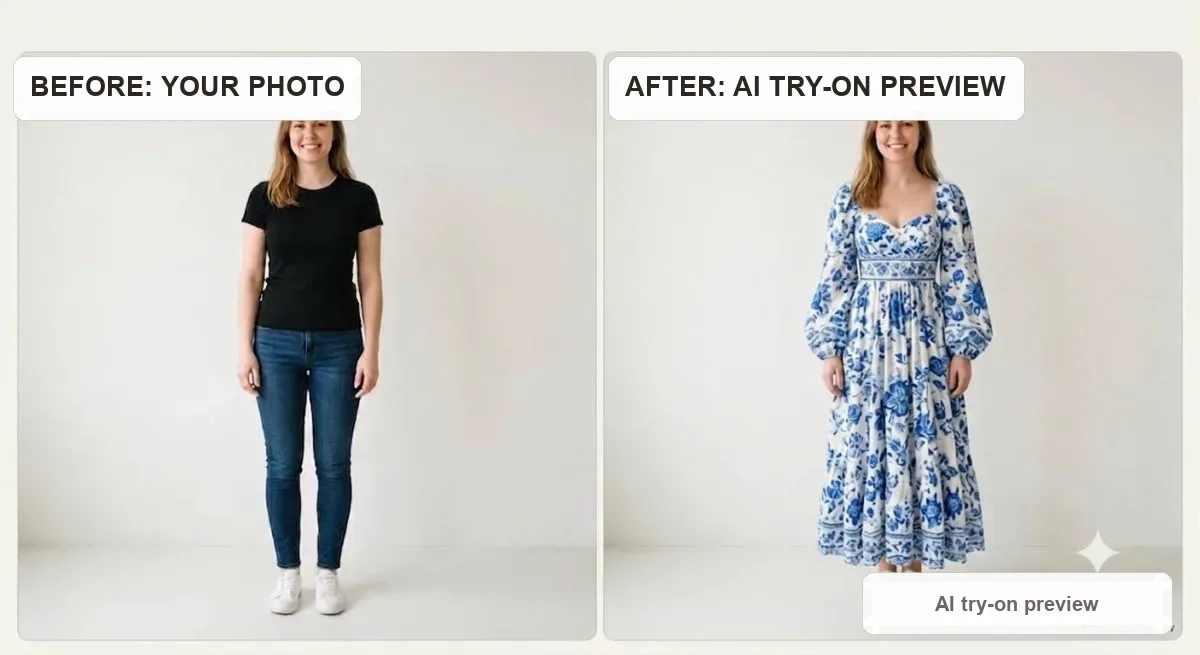
- She previewed both with an AI virtual try-on, checking the trouser fit and the bag colour against her palette, then bought once with no returns.
Those 30 pieces produce well over 50 sensible outfits, far more than her old, crowded closet ever gave her. That is the power of building deliberately rather than by accident.
A work capsule wardrobe
Professional dressing has its own rhythm. Two pairs of well-cut trousers, a skirt or a second dress, and a couple of blazers form a strong backbone in your base neutrals, with blouses and knits rotating on top. Match your formality to your actual office. Here is how few pieces a full work week really needs.
- Monday: tailored trousers, white shirt, blazer.
- Tuesday: knit dress with ankle boots.
- Wednesday: dark jeans, blouse, structured cardigan.
- Thursday: skirt, fine-knit top, blazer.
- Friday: trousers, tee, relaxed jacket.
Common mistakes to avoid
- Buying for a fantasy life. If you spend most days at a desk and school pickup, a capsule full of cocktail dresses gathers dust. Build for your real week.
- Ignoring your palette. One rogue purchase in a clashing colour can strand a brilliant piece. Before buying, ask whether it pairs with three things you own.
- Chasing trends too hard. Let trends appear in a single accessory or accent piece, never in your core staples.
- Confusing fewer clothes with deprivation. If a piece brings you joy and earns its wear, it belongs. Intentional does not mean joyless.
Shop your capsule confidently
Once you know your gaps, shopping becomes calm and targeted. You are hunting for specific pieces to complete a plan, not wandering the shops hoping something jumps out. Write down what your capsule is missing before you buy; a short list is the best defence against impulse purchases.
Fit uncertainty is the biggest reason people return clothes or leave them unworn, and this is where an AI virtual try-on changes the game. Instead of guessing how a blazer or dress will look, you preview it on your own image before spending a penny. Picture each new piece in at least three outfits with things you own, and map looks in advance using ready-made outfit templates. For anything pricey, give yourself a 48-hour rule: desire that survives two days is usually a real need.
Frequently asked questions
How many items should a capsule wardrobe have?
Most people find 30 to 40 pieces per season works well, not counting underwear, sleepwear, activewear, or special-occasion outfits. Treat it as a guide and adjust to your lifestyle.
How do I build a capsule wardrobe from scratch?
Follow the six-step method above: audit what you own, choose a colour base, build core staples, prioritise fit, fill only the real gaps, and refresh with the seasons. Shop your own clothes first, then add quality pieces gradually.
Can I have a capsule wardrobe on a tight budget?
Absolutely. It is one of the most budget-friendly approaches to style because you buy fewer pieces and wear them far more. Start with what you own and add quality staples as your budget allows.
How do I avoid buying the wrong size online?
Know your measurements, check each brand's size chart, and use an AI virtual try-on to preview fit and colour before you buy. That dramatically cuts returns.
The bottom line
Building a capsule wardrobe is not about owning less for its own sake; it is about owning better and wearing everything you keep. Audit what you have, settle on a flexible colour base, invest in well-fitting staples, and let the collection evolve with the seasons. Within a couple of cycles, nothing in your closet is dead weight and every piece pulls together. When you add a piece, shop with a list and use an AI virtual try-on to see it on yourself first.
Ready to try it yourself? Upload a photo and see any outfit on you in seconds, and your first try-ons are free. Start a try-on →
One useful style tip a week
What to wear, how to size, and new try-on features. Short, useful, unsubscribe any time.
Some links on this page are affiliate links. We may earn a commission when you buy through them, at no extra cost to you. Learn more.